
Section:
KEYWORDS
- Neuromodulation
- Asynchronous stimulation
- Cortico-spinal input
- Multi-electrode array
- Epidural interface
- Spinal reflexes
- Electromyograms
Potentiation of synaptic efficiency in spinal networks is reflected in the magnitude of modulation of spinally and supraspinally motor-evoked responses. After spinal cord injury, volitional control can be facilitated when elicited by pairing cortical and peripheral nerve stimulations. To facilitate synaptic potentiation of descending input with epidural electrical stimulation of the spinal cord alone, we designed a novel neuromodulation method called Dynamic Stimulation (DS), using patterns derived from a hindlimb EMG signal during stepping. DS was applied dorsally to four lumbosacral segments through a high-density epidural array composed of 18 independent platinum-based micro-electrodes. At the interface array/spinal cord, the temporal and spatial features of DS neuromodulation affect the entire lumbosacral network, particularly the most rostral and caudal segments. In fully anesthetized adult female rats, DS induced a short-lasting increase in spinal cord excitability and generated a more robust potentiation of spinally-induced motor output compared to tonic stimulation. Further, DS facilitated weak cortical input to recruit muscle contractions. Thus, DS has unique features necessary for amplifying both peripheral and supraspinal input to spinal locomotor networks compared to traditional tonic waveforms, which in turn elevate the potential to regain significant levels of functional recovery after a spinal lesion.
SCIENTIFIC BACKGROUND
A spinal cord injury (SCI) has consistent social costs, due to a high incidence on the youngest and most productive population and dramatic and disabling consequences, which can hardly be alleviated by the very few and controversial therapeutic treatments. In a recent report, epidural electrostimulation combined with an intense training enabled transient recovery of conscious motor control of legs in four volunteers with a complete spinal cord injury. Despite the highly variable extent of their clinical improvement, this is an astonishing discovery, whose mechanisms are still unknown. Much effort is currently focused on replicating those results towards a clinical application. The main aim of the research prior to the invention, though, was to understand the involved mechanisms, which would allow the design
of an innovative neurorehabilitation that extends and improves functional recovery after SCI. Ultimate goals of this study are the development of new breakthrough and versatile technologies and of the first targeted pharmacological treatment to restore functions after a SCI.
TECHNICAL FEATURES
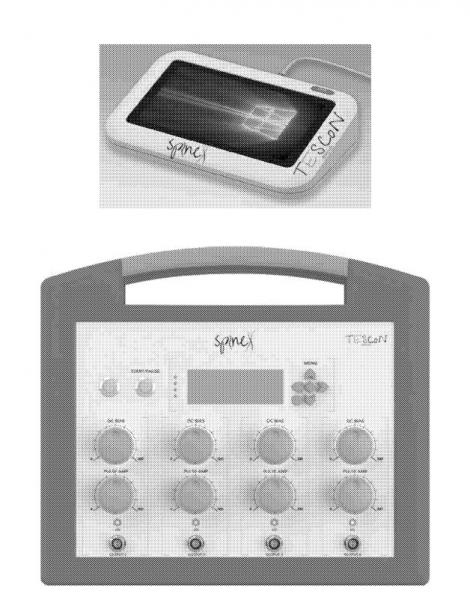
In various embodiments electrical stimulators are provided for transcutaneous and/or epidural stimulation. In certain embodiments the stimulator provides one or more channels configured to provi de one or more of the following stimulation pattems: i) monophasic electrical stimulation with a DC offset; ii) monophasic electrical stimulation with charge balance; iii) delayed biphasic electrical stimulation with a DC offset; iv) delayed biphasic electrical stimulation with charge balance; v) amplitude modulated dynamic stimulation; and/or vi) frequency modulated dynamic stimulation.
A transcutaneous or epidural electrical spinal cord stimulator, said stimulator comprising one or more channels configured to provide one or more of the following stimulation pattems:
i) monophasic electrical stimulation with a DC offset;
ii) monophasic electrical stimulation with charge balance;
iii) delayed biphasic electrical stimulation with a DC offset;
iv) delayed biphasic electrical stimulation with charge balance;
v) amplitude modulated dynamic stimulation; and/orvi) frequency modulated dynamic stimulation.
ADVANTAGES
- DS potentiates motor responses induced by segmental single pulses applied to the spinal cord cord;
- DS is more effective than standard stimulation in potentiating weak spinally-evoked motor responses;
- Repetitive delivery of DS exploits the effects of DS;
- Increasing the excitability of spinal networks through DS facilitates corticospinal input;
- Repetitive DS restores the spinally-evoked motor responses suppressed by a spinal cord contusion;
- Unlike many studies involving neurorehabilitation, our strategy does not target the lumbar central pattern generator for locomotion, but is centered at the site of lesion to promote reconnection along adjacent segments;
- Another original point of this research is that the continuous electrostimulation of the lesioned cord is performed in an acute setting (in the first three hours after injury). This finding suggests the possibility to employ novel DS, epidurally and/or transcutaneously, to the lesioned spinal cord as a first surgical intervention to limit the loss of functions following a spinal cord injury.
POSSIBLE FUTURE DEVELOPMENTS
The construction of a stimulating device able to supply the Dynamic Stimulation (DS) protocol for clinical purposes and its commercialization
INVENTORS: Victor Reggie Edgerton, Parag Gad, Evgeniy I. Kreydin, Giuliano Taccola
OWNERS: SISSA, UCLA, University of Southern California
PATENT PRIORITY NR PCT/US20/33830 dated 20/05/2020


