
Section:
KEYWORDS
- Biocompatible conductive adhesive
- Peripheral nerve repair
- Neural interfaces
- Indole-based materials
- Neuroprosthetic integration
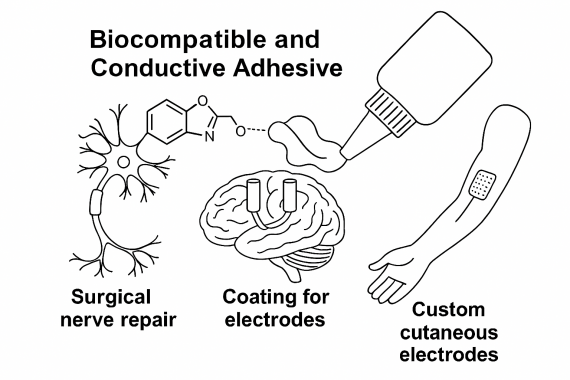
We propose the pharmaceutical preparation of a biocompatible and conductive adhesive material capable of promoting charge transfer between neural structures. The Invention (provisional name: BioGluole.Net) consists of an indole-structured derivative dispersed in a cyanoacrylate matrix, commercially available as surgical adhesives or as multipurpose adhesives (Attack). The innovative indole compound is prepared ad hoc through a highly efficient liquid-phase synthetic procedure starting from commercially available reagents.
ADVANTAGES
Current strategies for peripheral nerve repair mainly rely on surgical suturing techniques or the use of experimental substrates to promote regrowth of interrupted fibers. BioGluOle.Net enhances electrical conduction at the injury site by acting as a neural conduction facilitator.
BioGluOle.Net also allows stronger anchoring of implantable microelectrodes in the central nervous system, such as deep brain stimulators or epidural electrodes placed on the spinal cord. Although integrated electronics for the central nervous system is a rapidly growing field (e.g., Neuralink, Neuronexus), implantable electrodes still suffer from a limited functional lifetime due to biological responses that dramatically reduce their performance after only a few months. The main issues compromising medium- to long-term use of such technologies are twofold. First, mechanical stresses associated with normal body movements generate micro-frictions between implants and the cellular interface, deteriorating the electrical contact with neural structures. Second, the presence of an aqueous microfilm surrounding the electrodes enables immune cells to reach the implantation site, promoting fibrosis and encapsulation of the foreign body, thereby increasing surface impedance and degrading performance.
Both issues are mitigated by a thin BioGluOle.Net coating, which acts as an electrical cement that firmly anchors the device to the implantation site and removes the aqueous microphase between the electrodes and neural structures.
Furthermore, BioGluOle.Net enables the fabrication of electrical tattoos, in which surface electrodes for muscle or transcutaneous spinal stimulation are custom-shaped according to specific needs through subcutaneous application of the adhesive and conductive material.
The technology was validated by a multidisciplinary team with expertise in chemistry, engineering, pharmaceutical technology, and cellular biology. The team demonstrated the solubility of the indole compound and its ability to restore conduction across severed nerve fibers.
POSSIBLE APPLICATIONS
- as a surgical adhesive for peripheral nerves,
- as a coating for metallic electrodes to improve the stability and integration of neuroprostheses,
- as a custom-made cutaneous electrode.
INVENTORS: Giuliano Taccola, Andrea Spallarossa
PATENT PRIORITY NR.: IT102026000008647, filed on 30/03/2026. Title: “COMPOSIZIONE ADESIVA CONDUTTIVA PER IL RIPRISTINO DI CONDUZIONE ELETTRICA”, Inventors prof. Giuliano Taccola (SISSA) and prof. Andrea Spallarossa (Università degli Studi di Genova) - 50% co-ownership SISSA/UNIGE.


